
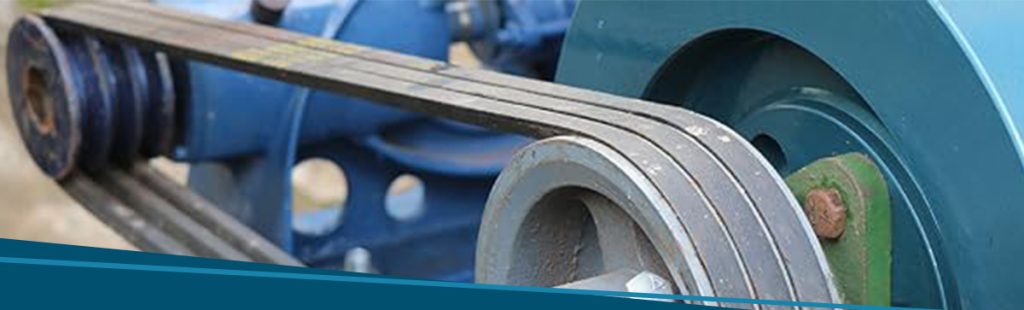
When most people think about belts in the oilfield, pump jacks usually come to mind first. While they’re a critical component of pumping units, belts are also found throughout oil and gas operations—in compressors, generators, fans, blowers, pumps, and processing equipment.
In all of these applications, the belt may seem like a small component, but it plays a major role in equipment reliability. Choosing the right belt can help reduce maintenance, improve efficiency, and prevent unnecessary downtime.
One of the most common questions we hear is:
What’s the difference between a traditional V-belt and a cogged belt?
Traditional V-Belts: Proven and Reliable
Traditional V-belts have been used across industrial applications for decades. Their wrapped construction provides dependable performance in standard operating conditions and offers a cost-effective solution for many applications.
For equipment running under moderate loads and consistent temperatures, a conventional V-belt can be an excellent choice.
However, not every application is operating under ideal conditions.
Cogged Belts: Built for Demanding Environments
Cogged belts, sometimes called notched belts, feature grooves along the inside of the belt. These grooves allow the belt to flex more easily around pulleys, reducing internal stress during operation.
That improved flexibility often translates into:
- Lower operating temperatures
- Improved efficiency
- Better performance on smaller pulleys
- Reduced internal strain
- Longer belt life
For equipment that runs continuously, carries heavy loads, or experiences frequent starts and stops, these advantages can add up quickly.
Heat Is the Real Belt Killer
When discussing belt life, one factor consistently rises to the top: heat.
Excess heat accelerates belt wear, hardens rubber compounds, reduces flexibility, and can ultimately lead to premature failure.
Many operators focus on horsepower, pulley size, or load requirements when selecting a belt, but temperature often has just as much impact on performance and longevity.
Because cogged belts flex more efficiently and generate less internal friction, they typically run cooler than traditional wrapped belts. In demanding applications, that reduction in heat can translate to longer service intervals and improved reliability.
Simply put:
Heat creates wear. Less heat often means more belt life.
Cold Weather Matters Too
Canadian operators know belts don’t just have to survive the heat—they also have to perform in extreme cold.
As temperatures drop, belt flexibility becomes increasingly important. Startup can place significant stress on a belt that has become stiff from cold weather exposure.
Cogged belts generally maintain better flexibility in lower temperatures, allowing them to bend around pulleys with less strain. This can help reduce startup stress and contribute to more consistent performance during harsh winter conditions.
So Which Belt Should You Choose?
The answer depends on the application.
A traditional V-belt remains a reliable and cost-effective solution for many standard operating environments.
However, if your equipment is exposed to heavy loads, long run times, frequent temperature swings, or harsh operating conditions, a cogged belt is often the better long-term investment.
The right belt doesn’t just keep equipment running—it can help reduce maintenance costs, improve efficiency, and extend equipment life.
And when production depends on uptime, those benefits matter.